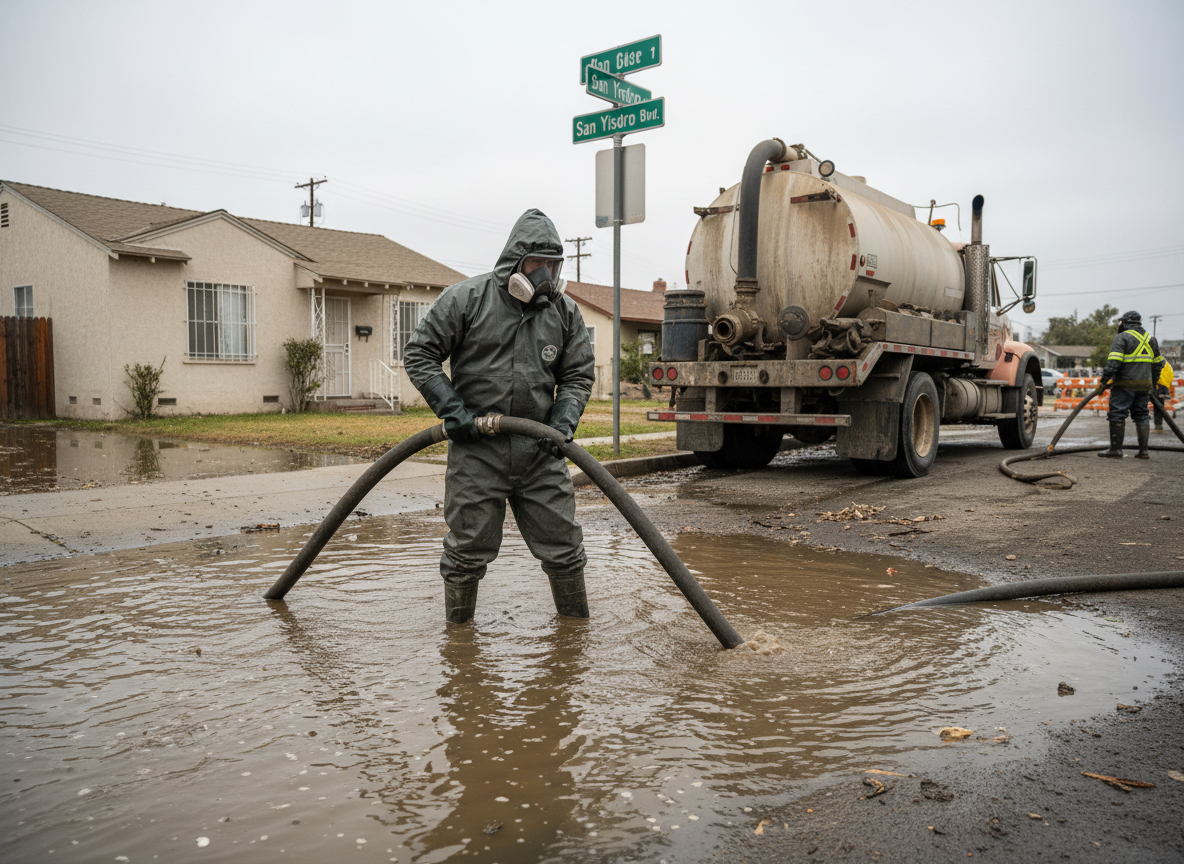
Sewage backups in San Ysidro often trace to older cast-iron lines that run under homes built before the 1970s expansion around the Port of Entry. When these lines fail, waste migrates quickly through the clay-heavy soil typical of the area and pools in crawl spaces or slab foundations. Technicians must remove all affected porous materials such as drywall, carpet pad, and subfloor sections that cannot be fully sanitized, then apply EPA-registered disinfectants followed by negative-air drying to prevent bacterial growth in the mild coastal humidity.
Work near the San Ysidro Port of Entry and Downtown requires extra containment because many lots sit close together with shared drainage. Crews set up physical barriers and HEPA air scrubbers before extraction begins so aerosols do not drift into neighboring homes in National City or Chula Vista. In winter, even moderate rain can overwhelm aging municipal lines, pushing sewage higher into living spaces than in drier months, which changes both the volume of material removed and the drying time needed.
San Diego County health rules require documented removal of all Category 3 water and verification that surfaces meet clearance standards before reconstruction. Technicians log every step, photograph hidden damage behind cabinets or under Larsen Field-adjacent homes, and leave written disposal manifests for the property owner. Skipping any of these steps leaves residents at risk of lingering pathogens that thrive in the region’s consistent moisture.
Technician insight
In San Ysidro, the thing that catches most people out with sewage cleanup is how quickly waste travels through the clay soil around the Port of Entry after even light winter rain, pushing contamination farther under slabs than homeowners expect.
Basement Backup in Downtown San Ysidro
A homeowner near Larsen Field reported rising water through the floor drain after overnight rain. We traced the line to a cracked clay pipe common in pre-1970 homes, removed saturated drywall and carpet, sanitized the concrete, and dried the space over three days to keep mold from forming in the coastal humidity.
How it works
- 1
Emergency Assessment
Arrive within the hour, identify the source, and map all affected rooms while the property remains occupied or vacant.
- 2
Extraction and Removal
Pump standing waste, cut out saturated materials, and bag debris for licensed transport out of San Ysidro.
- 3
Cleaning and Disinfection
Apply hospital-grade antimicrobials to all hard surfaces and treat hidden cavities with fogging equipment.
- 4
Drying and Clearance
Run industrial drying and air scrubbing, then test moisture levels before signing off for rebuild.
Pricing
Pricing varies with the amount of material removed, access difficulty in older San Ysidro homes, and total square footage affected.