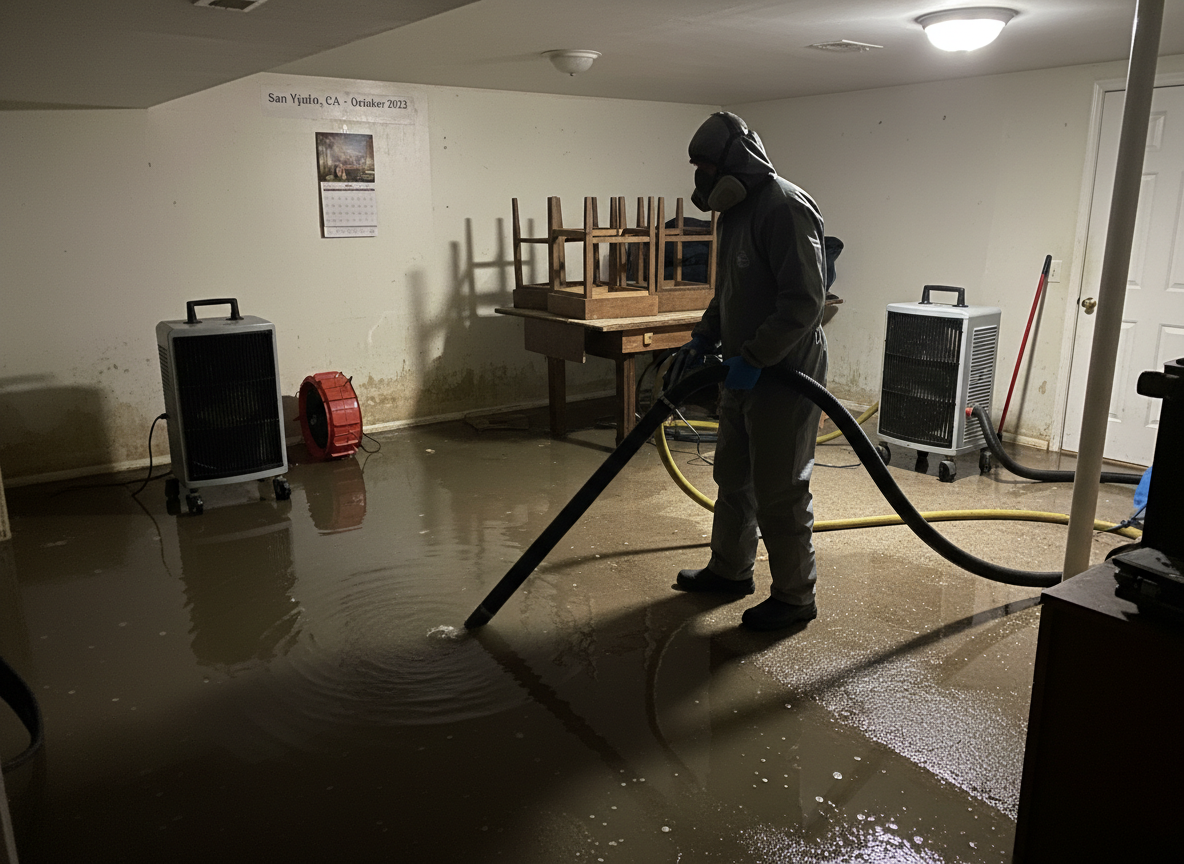
San Ysidro homes built before the 1980s often sit on concrete slabs with limited under-slab vapor barriers, so water from a burst supply line or roof leak travels quickly into adjacent rooms and under flooring. In the mild coastal Mediterranean climate, daytime temperatures rarely drop low enough to evaporate trapped moisture on their own, allowing hidden saturation to reach drywall and base plates within hours. Crews start by mapping moisture with meters along the slab edges and up walls to the height where capillary action stops, then remove baseboards and drill weep holes to release water before it migrates toward the San Ysidro Port of Entry area where commercial buildings share walls.
When water enters from the street side near Larsen Field or from overloaded storm drains during rare heavy rains, the soil along W San Ysidro Blvd tends to hold moisture longer because of the flat grade and older sewer laterals. This changes the job because extraction must continue until relative humidity in the subfloor drops below 40 percent or risk returning mold growth weeks later. Technicians place air movers in a directed pattern that pushes air across the slab toward exhaust points rather than recirculating damp air inside the structure.
Nearby cities like Chula Vista and National City share the same water table influence, but San Ysidro properties closer to the border crossing see more frequent slab-edge leaks from irrigation lines that run along property boundaries. Emergency cleanup here includes separating wet carpet padding immediately and bagging it on site to prevent cross-contamination when moving materials through narrow hallways common in the older housing stock.
After extraction, dehumidifiers sized for the square footage run continuously while crews monitor daily moisture logs. This step is critical because the consistent moderate temperatures in San Diego County slow natural drying and allow salts in the soil to wick upward and damage lower wall finishes if left unchecked.
Technician insight
In San Ysidro, the thing that catches most people out with Emergency water cleanup is how the flat terrain and older slab-on-grade homes near the Port of Entry let water travel under walls into neighboring units before anyone notices; our mild coastal climate keeps the moisture from evaporating on its own, so you have to chase it all the way to the edge of the slab or it returns as musty odors weeks later.
Slab Leak Near Downtown San Ysidro
A supply line failed under a 1970s home two blocks from the San Ysidro Port of Entry, sending water across the slab and into the living room and hallway. Meters showed saturation extending under two interior walls and into the adjacent bedroom. Extraction removed standing water and wet padding the same afternoon; directed drying ran for four days until slab and wall readings returned to normal.
How it works
- 1
Arrival and Safety Assessment
Technicians arrive within the service area, shut off water sources if still flowing, and check for electrical hazards before any extraction begins.
- 2
Moisture Mapping
Meters and infrared cameras locate saturation in slabs, walls, and subfloors throughout the affected rooms and adjacent spaces.
- 3
Water Extraction
Truck-mounted and portable pumps remove standing water from floors and cavities, followed by removal of saturated carpet and padding.
- 4
Drying and Monitoring
Air movers and dehumidifiers are positioned for directed airflow across slabs; daily readings continue until moisture levels stabilize.
- 5
Final Clearance
Once readings meet drying standards, equipment is removed and the space is prepared for any needed repairs.
Pricing
Upfront quotes after inspection based on affected square footage and materials involved.